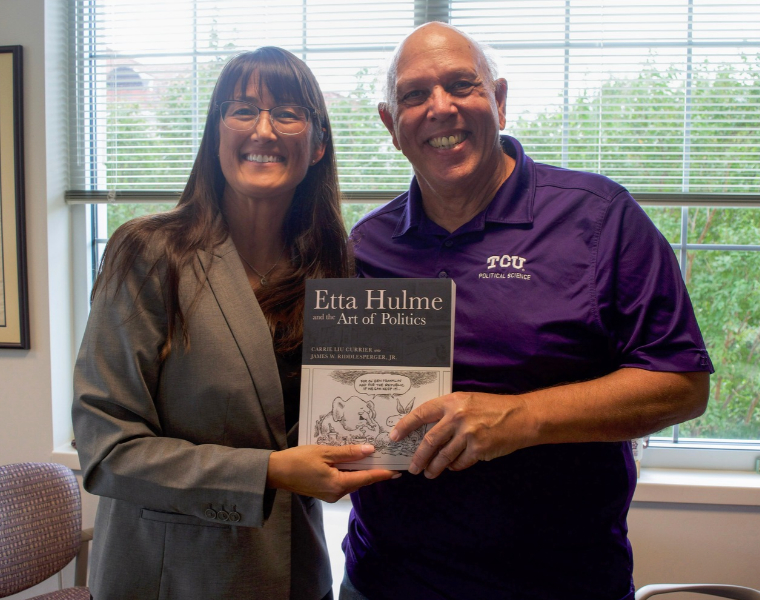
Drawing on History: TCU Political Scientists Explore Etta Hulme’s Political Legacy
Political cartoons have been part of Carrie Liu Currier and James “Jim” Riddlesperger's TCU classrooms for years.
Currier, professor of political science, regularly begins class with a political cartoon projected on the screen, while Riddlesperger, emeritus professor of political science, estimates he has used about 25 cartoons by longtime syndicated Fort Worth Star-Telegram editorial cartoonist Etta Hulme in his course materials over the decades.
“There’s an old expression that many truths are told in jest,” Riddlesperger said. “And that’s the secret of political cartoons: telling a funny story that teaches something about politics.”
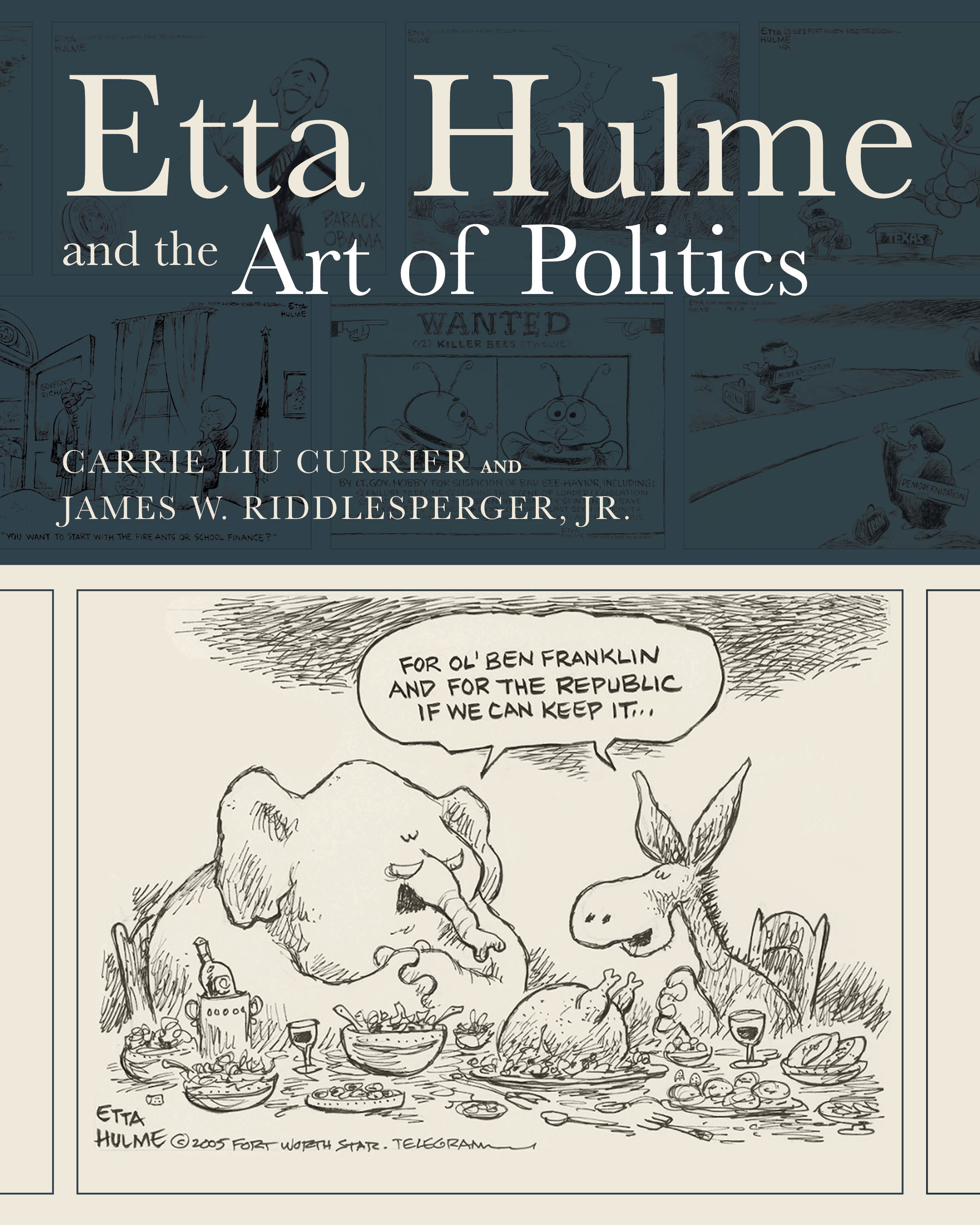
That shared appreciation eventually developed into a years-long research project examining Hulme's work and legacy. Currier and Riddlesperger explored thousands of cartoons spanning Texas, American and international politics, uncovering the political moments behind them and the artistry and insight that made Hulme a nationally recognized editorial cartoonist.
Their research is featured in Etta Hulme and the Art of Politics, published by TCU Press, the first scholarly examination of Hulme's work and legacy.
Thousands of Cartoons, Decades of Politics
The project began after TCU Press published a collection featuring Harold Maples, another Star-Telegram editorial cartoonist. Riddlesperger, a member of the TCU Press editorial board, suggested Hulme deserved similar attention. When he was encouraged to take on the project, he approached Currier about collaborating.
Their different areas of expertise helped shape the research. Riddlesperger brought decades of scholarship on Texas and American politics, while Currier's expertise in international relations provided another lens for examining Hulme's wide-ranging work.
Much of their research centered on the Etta Hulme Papers at UTA Libraries Special Collections, which holds nearly 8,000 cartoons from Hulme's collection.
“You go down a rabbit hole,” Currier said. “I’m looking for something that fits in this kind of theme of what I’m hoping to find. And then next thing you know, four hours later and you find one cartoon that fits.”
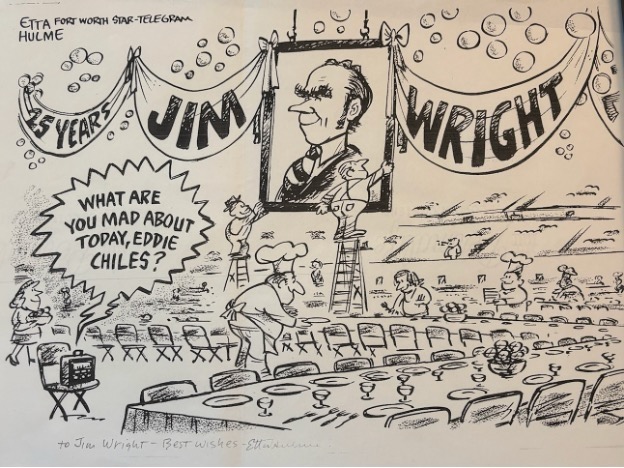
Their search extended beyond UTA. They examined Hulme's early work for the Texas Observer, searched historical issues of the Star-Telegram and found an original Hulme cartoon in TCU's Jim Wright Collection that she signed and gave to the former U.S. House speaker and Fort Worth congressman.
A Fort Worth Voice with a National Reach
Hulme spent 36 years at the Star-Telegram, using her pen to take on presidents, Texas governors, members of Congress, public policy and international affairs. She eventually became the first female editorial cartoonist in the United States to achieve national syndication.
Her subjects included some of the biggest names in Texas political history, Lyndon B. Johnson, Sam Rayburn and Wright among them, and political affiliation offered little protection from her criticism.
“She was an equal-opportunity lampooner,” Riddlesperger said.
Wright, whom Currier and Riddlesperger both knew, sometimes found himself on the receiving end of her criticism.
Studying Hulme's work also brought unexpected discoveries. Riddlesperger said he had followed her cartoons for decades but had never fully considered her as an artist. The research gave him a new appreciation for her artistic talent and the respect she commanded among fellow cartoonists.
Currier found herself learning more about history as she investigated the context behind individual drawings.
“You think you have a good grasp on various things,” Currier said. “And just by the things that she would choose to include in her drawings, it just kind of gives you a lot of insight.”
Politics Through a Different Lens
Although Hulme drew in response to the politics of her day, Currier and Riddlesperger repeatedly encountered cartoons that still felt relevant. Her work confronted familiar themes including partisanship, polarization, political ambition and hypocrisy.
Understanding those cartoons required looking beyond the images. Currier and Riddlesperger returned to historical newspaper coverage to understand what was happening when Hulme created a piece and why she chose to portray an issue in a particular way.
That ability to distill a complicated political moment into something accessible is also what keeps political cartoons in their classrooms.
“The reason that Carrie and I use cartoons in our PowerPoint presentations is that they teach principles of politics to our students,” Riddlesperger said. “If they were just funny, so what?”
Hulme understood the other side of that equation, too: Sometimes making people think meant making them uncomfortable. Her work generated plenty of criticism, including an instance when someone mailed one of her cartoons back to the Star-Telegram riddled with bullet holes.
Her reaction? She laughed.
“She said, ‘I’m supposed to be provocative. If I’m not being provocative, I’m not doing my job,’” Riddlesperger recalled.
Decades later, Hulme's cartoons can still accomplish what Currier and Riddlesperger value about the art form in their own teaching: get people to look, laugh and then think.