TCU Professor Shares Research: Exploring Humanity in the Age of AI
“The real risk isn’t that AI becomes like us. The risk is that we become like it.” -Sage Elwell
For Sage Elwell, questions about technology and humanity are not just theoretical. They are personal.
Growing up in Kansas, Elwell spent time in a bronze-casting foundry his father built on their rural property. At 13 years old, he helped pour molten bronze for the first time — a moment that left a lasting impression.
“You have to complete the pour before the bronze cools,” Elwell recalled. “There’s no pause, no undo. That moment, doing something irreversible with others depending on you, is a pretty good description of what it feels like to be human right now.”
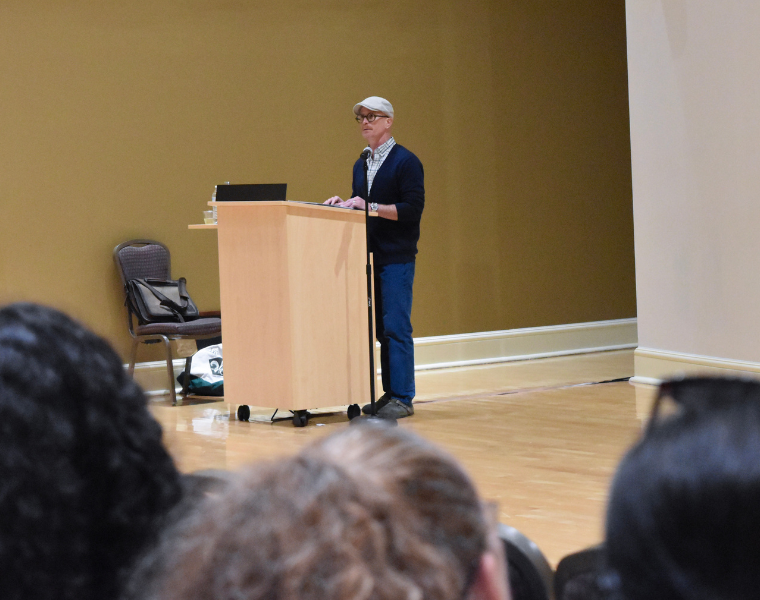
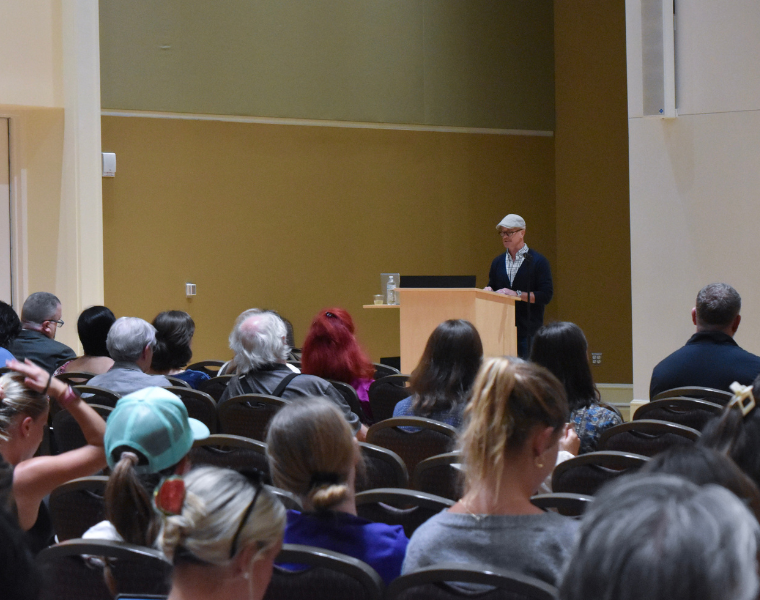
Elwell, professor of religion, shared various stories during the AddRan Distinguished Faculty Lecture and Celebration of Research and Creative Activities event. His talk, titled “Hot Mess: Bodies, Bronze, and Being Human in the Age of AI,” explored how artificial intelligence is reshaping the way people think about creativity, embodiment and the human condition.
Drawing on his research at the intersection of religion, art and digital culture, Elwell used the ancient craft of bronze casting as a metaphor for understanding modern technology.
The traditional “lost wax” casting process requires patience, risk and collaboration. Sculptors begin with clay, create molds and wax models, burn out materials in extreme heat and finally pour molten bronze into the mold. The process is messy and irreversible.
That messiness, Elwell argues, is not a flaw. It is central to what makes human life meaningful.
“Human life isn’t frictionless,” he said. “Living a fully human life is, for better or worse, a bit of a mess.”
Mistakes are Essential
Artificial intelligence, he argued, often moves in the opposite direction. Digital tools promise efficiency, optimization and fewer mistakes. While those technologies can expand creative possibilities, they also risk reshaping how people evaluate themselves and their work.
“The real risk isn’t that AI becomes like us,” Elwell said. “The risk is that we become like it. That we begin to judge ourselves by its standards.”
Throughout the lecture, Elwell returned to the idea that imperfection, vulnerability and embodiment are not problems to eliminate but realities that shape human experience.
His own life has reinforced that perspective. Born with a congenital condition that required numerous surgeries, Elwell said his experiences with illness and recovery shaped how he understands the body, not as a machine to optimize, but as something fragile and deeply human.
As artificial intelligence becomes more integrated into daily life, Elwell believes society faces an important choice.
“We are at an inflection point,” Elwell said. “How do we integrate AI into our lives?”
The question is not whether AI will become part of everyday life, but how society integrates it while preserving what makes us human.