TCU English Students Explore the Legacy of Phillis Wheatley Peters
In a time when stories are often told in 30-second clips, a recent AddRan event asked audiences to slow down and reconsider a life from the 18th century.
Through a screening of In Search of Phillis Wheatley Peters, students helped bring new attention to a figure whose story still feels unfinished.
Organized through an English research seminar, the event centered on Phillis Wheatley Peters, America’s first published Black poet, while also giving students the opportunity to shape the conversation around her legacy.
“Wheatley Peters is vital to literary history and culture,” said Sarah Ruffing Robbins, Lorraine Sherley Professor of Literature and event organizer. “She fascinates and inspires us, and there is still so much we long to find out about her.”
The 35-minute documentary explores Wheatley Peters’ life and marriage to John Peters, a free Black man, revealing their efforts to build autonomy and dignity in Revolutionary-era Boston. But for students in the seminar, the project extended far beyond watching the film.
Engaging Audiences
Students helped plan, host and evaluate the event, gaining hands-on experience in public humanities work. That included pre-screening the film, drafting and workshopping questions and thinking about how to engage audiences encountering the material “fresh.”
“A major premise guiding the seminar is that humanities learning is exponentially greater when it’s done in community,” Ruffing Robbins said.
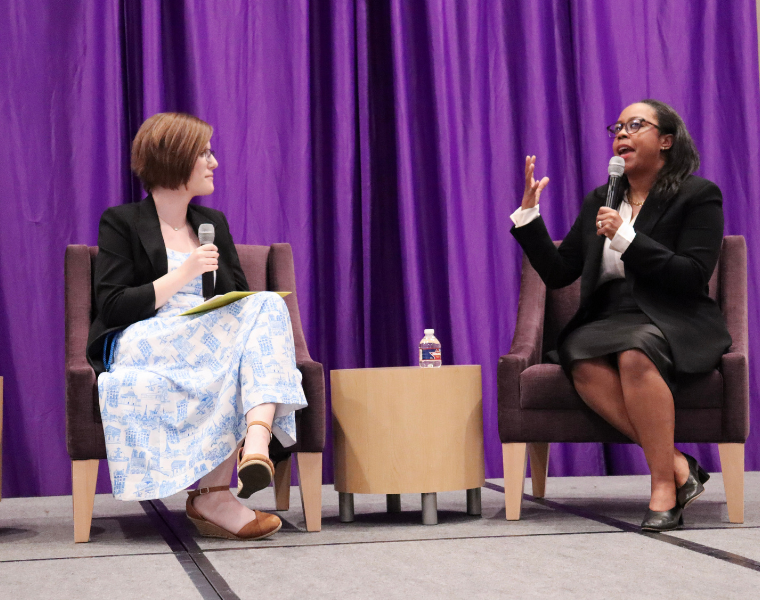
That collaboration came to life during a post-screening interview with filmmaker Leslie Askew and a few English students.
“We wanted to guide the audience through the film’s different themes and historical contexts while still making it feel like an organic conversation,” said Mason Patterson, English doctoral student. “It was exciting because our different backgrounds gave us the chance to ask a variety of questions.”
Patterson also emphasized the broader purpose behind the event.
“Public humanities work is more important than ever.”
“It’s an opportunity to create a space for people to connect with Wheatley Peters’ writing and life story and to think about her continued relevance,” Patterson said.
Reshaping Literary History
For undergraduate students in Ruffing Robbins’ research seminar, the experience reshaped how they see literary history. Sam Everett, a sophomore double major in English and sociology and a John V. Roach Honors College student, said studying Wheatley Peters revealed gaps in his own education.
“I think it’s tragic that it wasn’t until my second year of undergrad that I’d ever really learned about her,” Everett said.
Through course readings and the documentary, students also confronted the challenges of studying a historical figure whose story is incomplete. Much of Wheatley Peters’ poems remain lost.
“She had so few opportunities in her life to tell her own story,” Everett said. “I appreciate how the documentary draws on her letters and poems to try and critically fabulate it for us.”
Exploring Wheatley Peters’ legacy across scholarship, film and public discussion allows those gaps to be revisited in new ways.
“Each unique mode of storytelling gives you the chance to reach new audiences and view the subject in a different light,” Patterson said.
The event reflected a broader goal of the liberal arts: connecting classroom learning with real-world impact.
At TCU, that means students don’t just study history. They help bring it to life.